Thinking
Ageing Infrastructure’s Eureka Moment

Eva MacNamara
Director

Viewpoint feature by our Director, Eva MacNamara, in The Structural Engineer, published in June 2026.
A recent report on the UK’s ageing infrastructure should be a wake-up call to both structural engineers and asset owners, argues Eva MacNamara as it offers ways to change stewardship for the better and keep our infrastructure in service for longer.
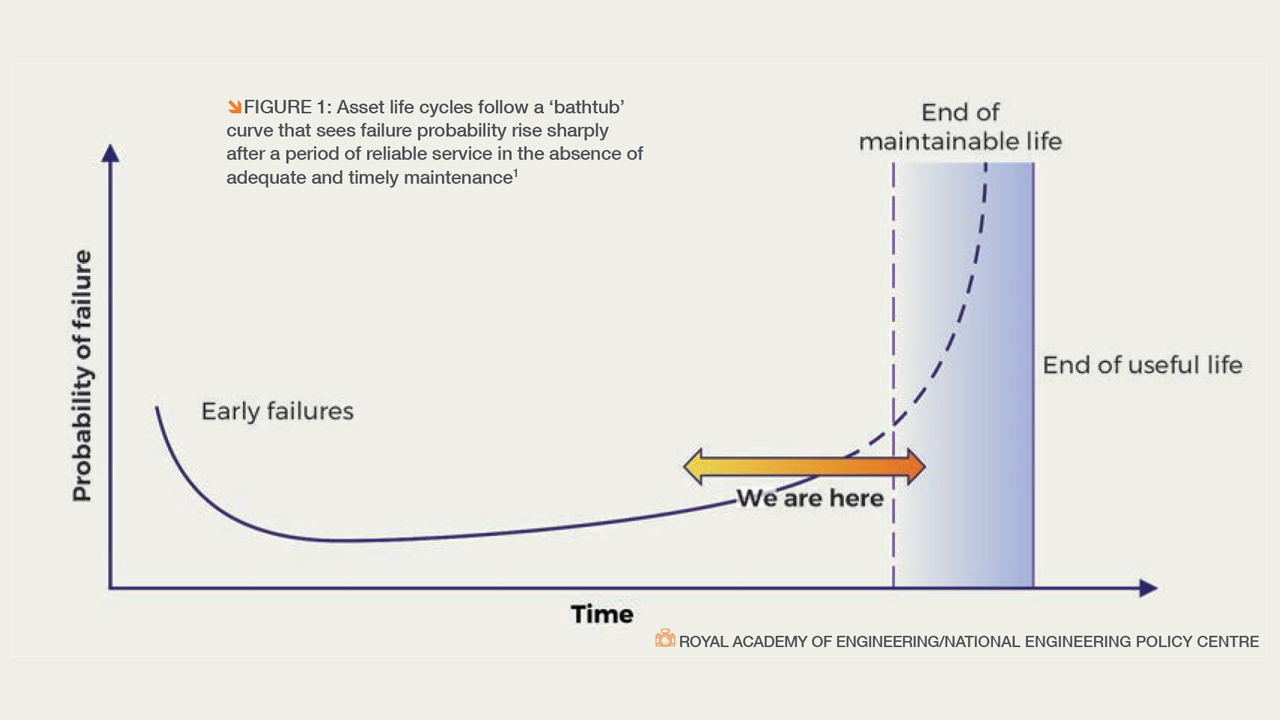
There’s a graph in the National Engineering Policy Centre’s (NEPC) Reviving our ageing infrastructure report that I keep coming back to. It’s neatly named the ‘bathtub’ curve and is a simple plot of failure probability over time that every structural engineer will recognise intuitively, even if they’ve never used it before.
Some assets fail through teething problems when they’re new, then settle into a long middle period of reliable service, before the probability of failure starts to climb steeply. Somewhere around that point, the asset has reached the end of maintainable life and, after that, no amount of maintenance will be useful in the long run. At that point, renewal or enhancement is the only answer.
The uncomfortable truth this report lays bare is that a significant proportion of the UK’s civil infrastructure is somewhere on that upward slope right now and the frequency of failures and pressures on the systems are exacerbated by climate change.
A large proportion of the strategic road network was designed and built in the 1960s and 1970s, and many of those structures are approaching, or have already reached, the end of their maintainable life. Network Rail manages 30,000 bridges, tunnels and viaducts, many of which were built over 100 years ago. Of the 70,000+ bridges managed by councils, 4.3% were reported as substandard in 2021. These aren’t small numbers.
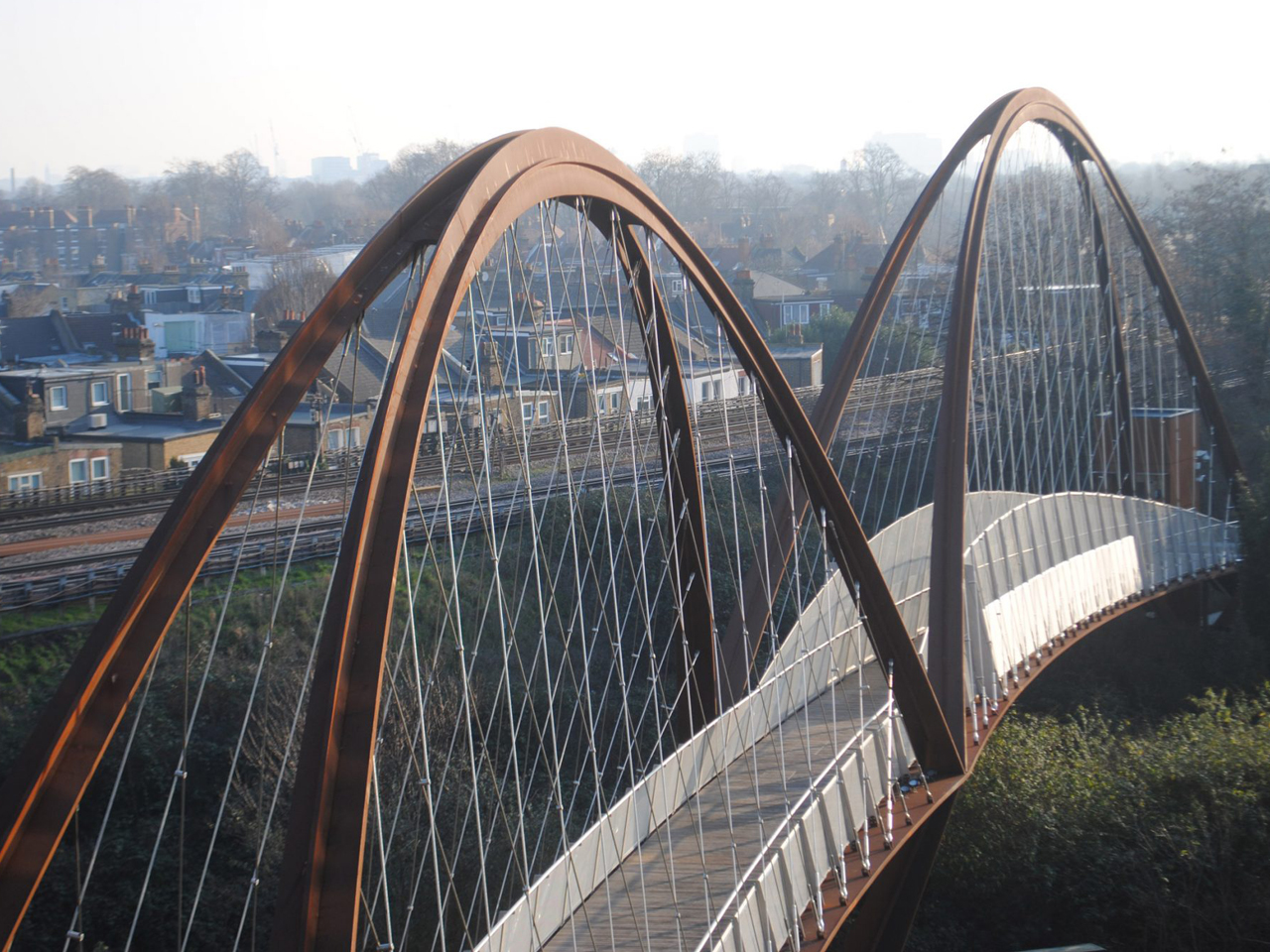
The case studies in the report reinforce the impact of not resolving the maintenance challenge: London’s Hammersmith Bridge is still closed to motor traffic after six years, the closure of Clifton Bridge in Nottingham briefly made it one of the world’s most congested cities, and the Nuneham Viaduct closure severed Oxford from London and rerouted 40 freight trains a day. These examples shouldn’t be perceived as isolated incidents; they should be understood as early indicators of what is coming if we don’t change course.
How can we change course?
As engineers, we understand this intuitively and many of us can point to examples anecdotally that we’ve seen or worked on. What the NEPC report does is assemble the evidence across sectors (including water, flood defence and transport) to show a sobering aggregate picture. It also, usefully, moves beyond the ‘why’ to address the ‘how’. Seven enablers of change are identified: strategy and regulation, financing, skills and capabilities, data, innovation, societal awareness, and system coordination. All seven are cross-cutting and all seven are of equal importance.
Crucially, none of those seven enablers are bridge-specific, which is rather the point, because the challenges facing our bridges are not unique to bridges. They are symptomatic of how we manage, fund and value ageing assets across the board. Short-term funding cycles reward reactive maintenance over proactive investment. Capital and operational budgets are siloed in ways that prevent whole-life decision-making. Asset condition data is incomplete or inconsistent, making it hard to build the business case for intervention before crisis occurs. And there is a cultural tendency, one many of us will recognise both in our professional and personal lives, that our infrastructure in taken for granted until it fails.
Download and read the full article here.
Image gallery